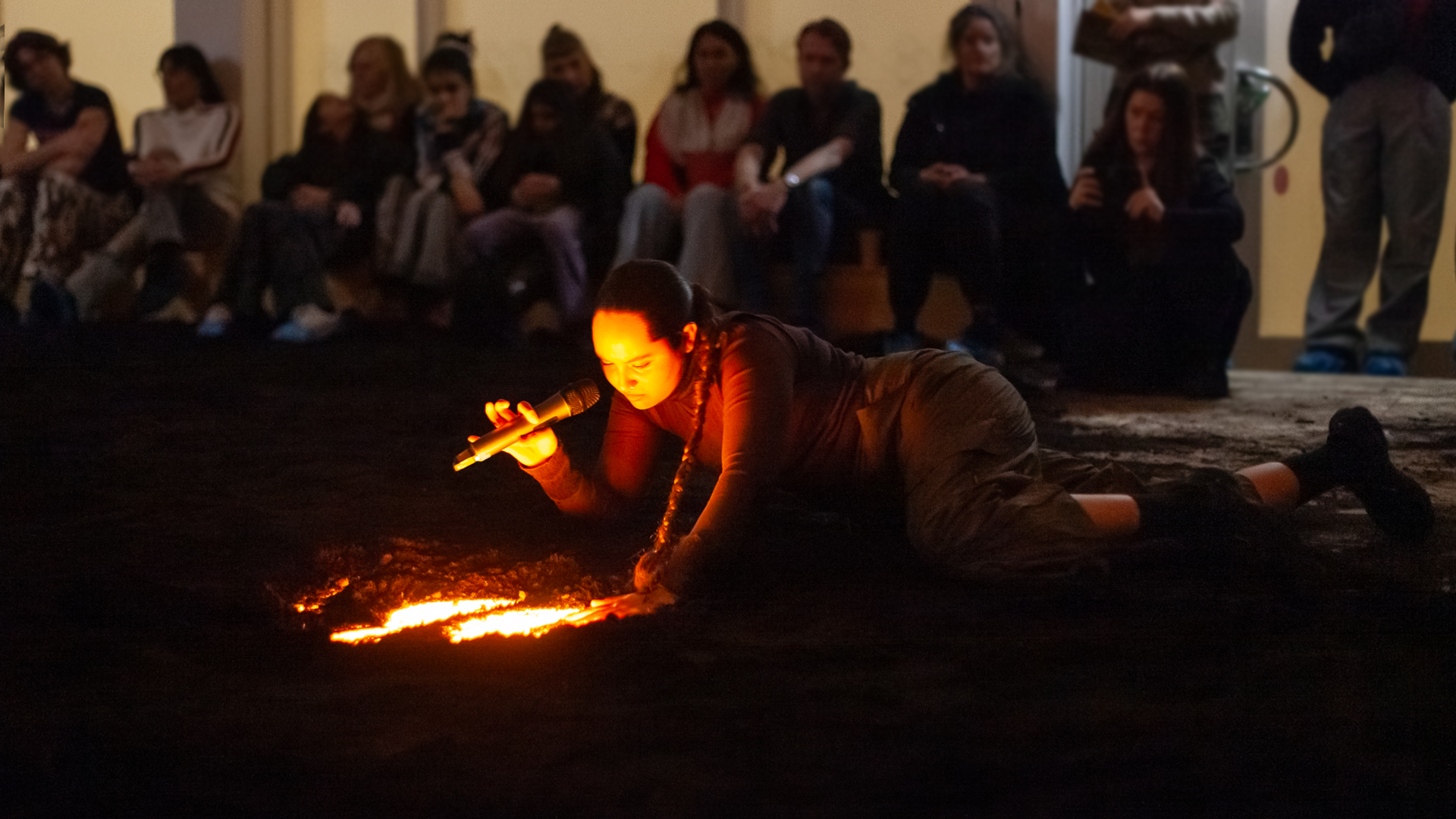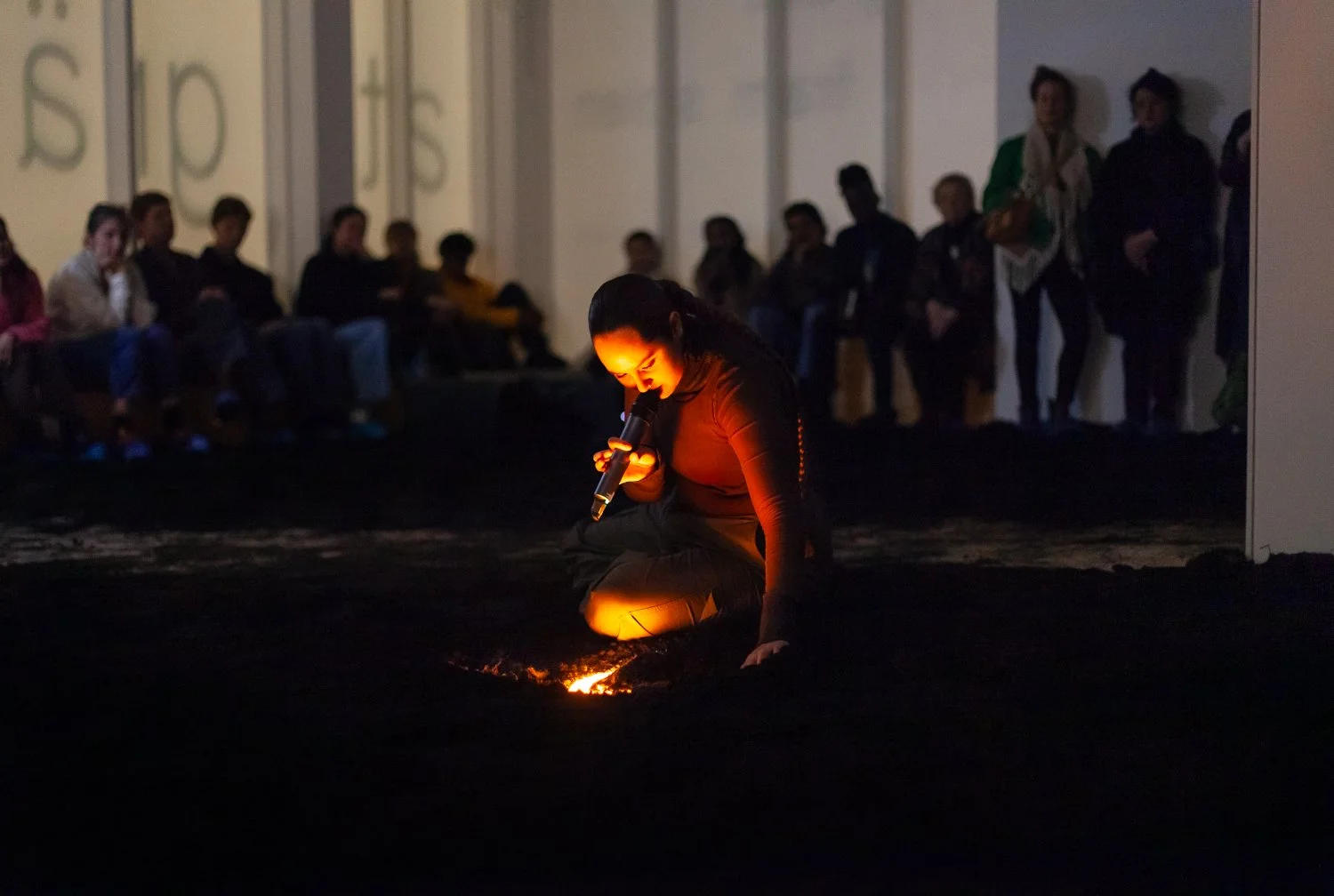
Image: courtesy of Amina Seid Tahir
MARAN is a performance by Amina Seid Tahir, staged for an audience lying down around her. In a dark, misty room, she moves to the rhythm of bells braided into her hair, then sits before her krar, an Eritrean lyre, and plays. Its strings carry songs of resistance alongside soft, lulling melodies. The sounds call the room to rest and to dreams, to water seeds for new worlds to grow. The work rereads the Nordic figure of the Maran, the night visitor whose name gave us the word nightmare, turning the bringer of bad dreams into their protector.
The krar is a five or six stringed lyre with a long political history in Eritrea, used to set resistance songs against the regime and as a source of power for the country’s resistance movements. Its vibrations are also said to heal, and the instrument has long featured in healing ceremonies. Under the Derg regime it was banned outright and branded a devil’s instrument, precisely because it had become a symbol of marginalised resistance.
The Maran, in Nordic folk belief, sat on men’s chests at night, pressed the air from them and filled them with dread. From her name grew the word mardröm, nightmare. Tahir reads her anew, through a queer Afro-Nordic lens, asking what the Maran does when she visits her own community. Here she moves among sleeping bodies not to weigh them down but to watch over them, the krar in her hands, the once feared curse now the protector of the dream.
Performance: Maran with Amina Seid Tahir
Date: 13 November 2026
Time: 18:00 – 20:30
Free to attend. RSVP to guarantee your spot; drop-ins welcome on a first come, first served basis.
Museum of Impossible Forms
Aallonhalkoja 9 L1
00540 Helsinki, Finland
-
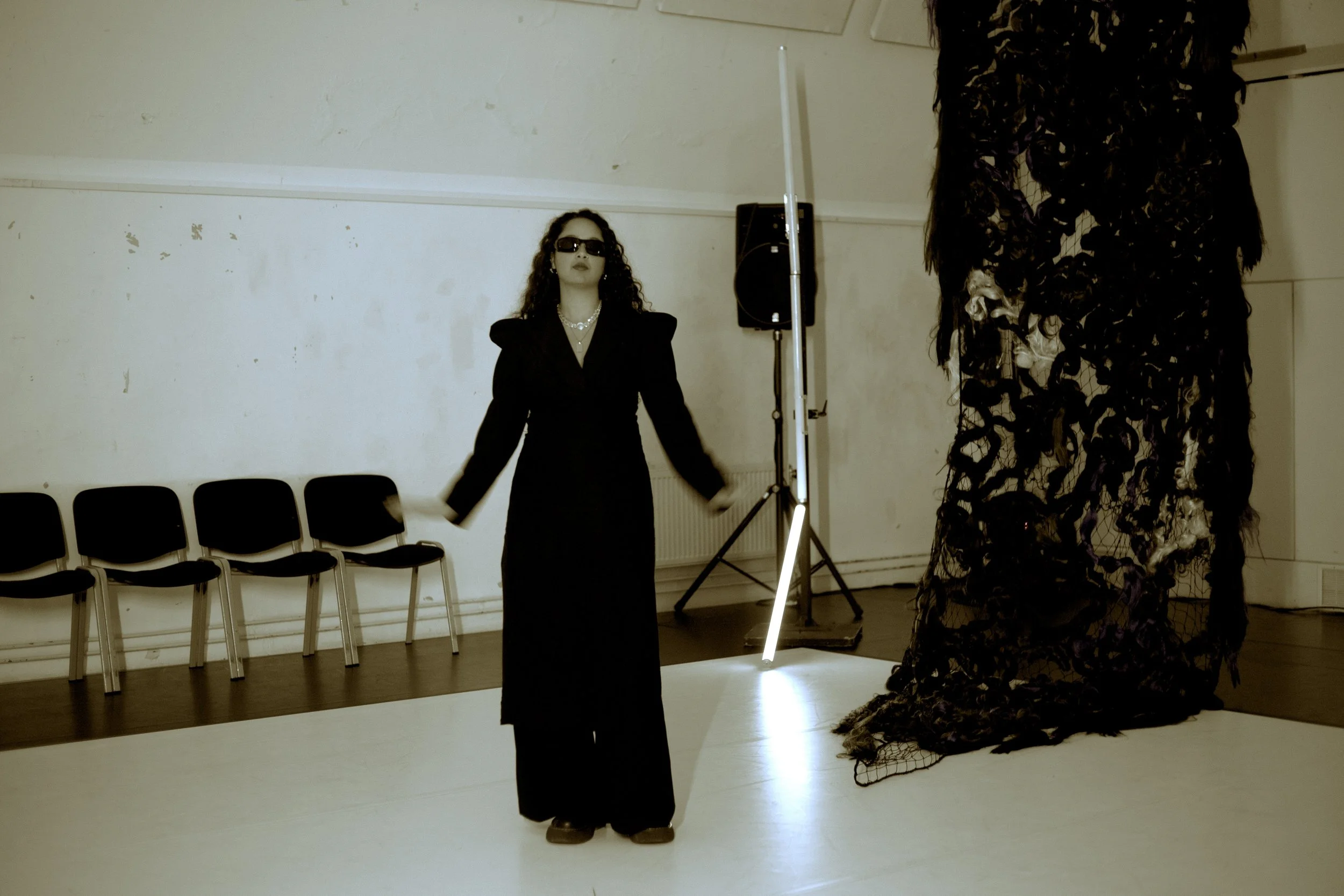
Amina Seid Tahir
Amina Seid Tahir (she/her) is a Swedish–Eritrean artist, musician and choreographer. Using the imaginary as a tool, she explores the idea of an Afro-Nordic folklore, a concept that weaves together narratives from Nordic folklore with experiences of being Afro-Swedish alongside Eritrean traditions. It is a way of creating mythologies, stories, and practices that reflect the intersection of being a queer Afro-Swede.
In her new work “lullabies and SPELLS,” she explores lullabies' ability to become a portal to radical dreams. The work draws upon the Nordic folklore of nightmares “Maran” and the Eritrean lyre “Krar”—the latter known both as a carrier of revolutionary songs and for its healing properties.
Her previous work has been presented across a variety of venues and contexts including Botkyrka Konsthall(SE), Primary (UK, Nottingham), Dance Umbrella
(UK), URB Festival - Kiasma Museum (FI), Rakete Festival (AT), ICE HOT (NO),
MDT (SE), Kampnagel International Summer Festival (DE), KUNSTENFESTIVALDESARTS (BE), New Sh*t (DK), Emergentia
(CH), Bâtard (BE), My Wild Flag (SE).
-